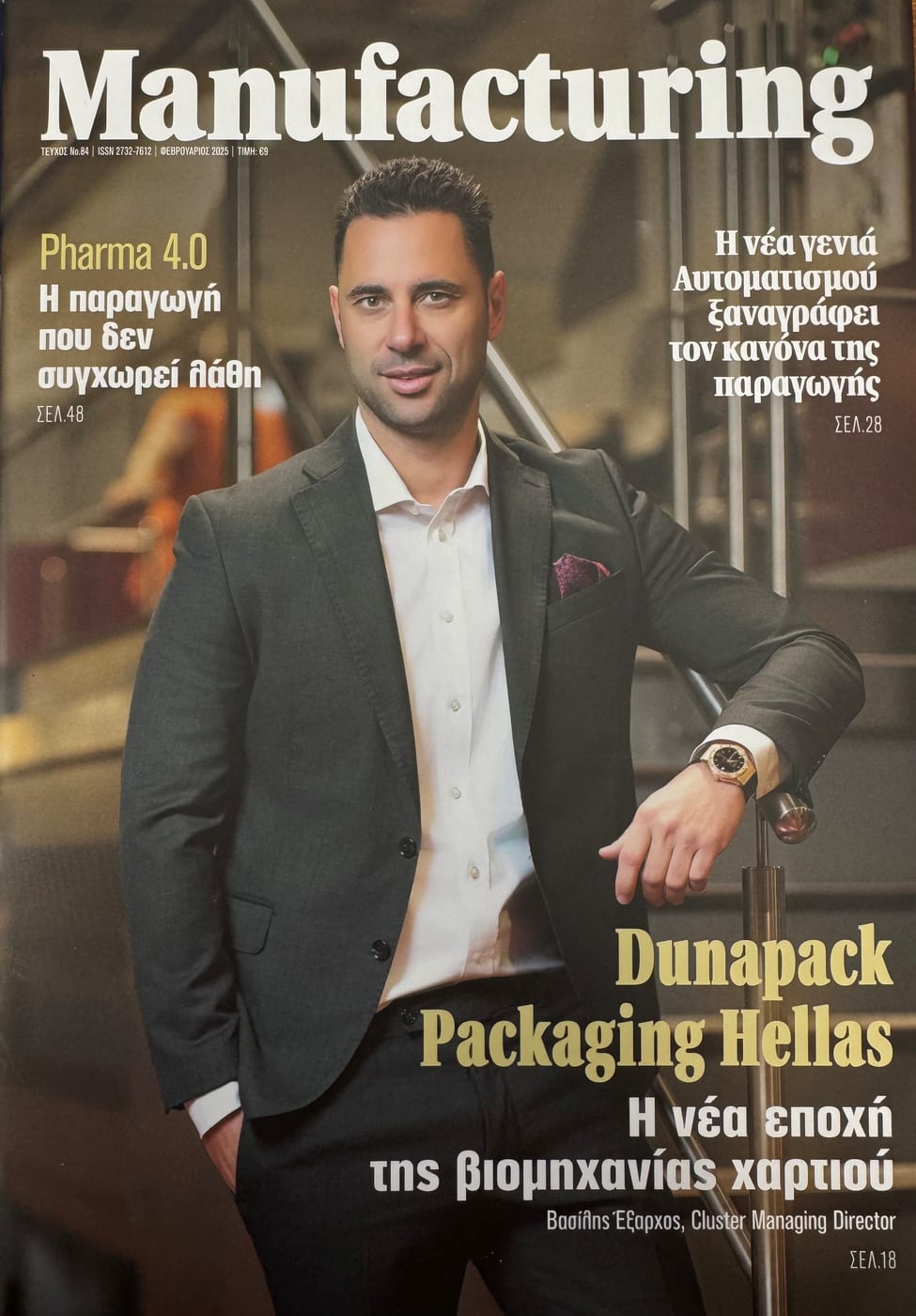
The Value of Paper: Innovation and the Environment
The Greek plant of Dunapack Packaging Hellas is evolving into a hub of technology and know-how for Southeastern Europe, investing in a new generation of production that combines efficiency, environmental responsibility and human ingenuity.
Paper is the oldest technology that refuses to grow old. From the first traces of writing to modern packaging, it has accompanied human progress. Upon it were written ideas, laws, strategies. And today it underpins a new chapter of industry: that of circularity.
Europe has already set its course. With the new Paper and Packaging Waste Regulation (PPWR), the use of paper as a primary packaging material is not a choice, it is a prerequisite. The recycling rate of corrugated board exceeds 90% and, at the same time, 88% of corrugated packaging comes from recycled material, according to FEFCO - The European Federation of Corrugated Board Manufacturers, making the sector one of the most successful links in the circular economy.
And as consumers demand products with a low carbon footprint, paper ceases to be merely a material. It becomes an expression of responsibility, a carrier of values and proof of consistency.
In Greece, the production of raw material is limited, yet processing has developed into a high-know-how industry. In this environment, Dunapack Packaging Hellas stands as a point of reference. A company that had the foresight to see in paper not only the raw material, but also the means of a deeper transformation.
Dunapack Packaging Hellas belongs to the Austrian Prinzhorn Group, a manufacturing organisation with a presence dating back to 1853 and activities ranging from paper recycling to the production of packaging. Today the group reports a turnover of approximately €2.3 billion and employs more than 10,000 people across 16 countries.
Dunapack Packaging is the division of the Prinzhorn Group that specialises in corrugated board, with 24 plants in 12 countries and production exceeding 2.8 billion square metres.
Within this European ecosystem, the Greek plant operates as a hub of technology and know-how in Southeastern Europe, an example of how a small-scale market can stand on equal terms with the large industrial centres. From this foundation begins the Greek story of Dunapack Packaging Hellas, a story of industrial maturity and faith in long-term investment.
The Industry of Resilience
The Manufacturing team visited the Dunapack Packaging Hellas plant in Schimatari.
There, where the massive paper rolls move with uninterrupted consistency and the cutting lines operate with absolute precision, the concept of resilience takes on physical form.
"We invested when everyone else was waiting. That made the difference," says Vassilis Exarchos, President HPPA of Dunapack Packaging.
Over the past seven years, investments have exceeded €65 million, while another €30 million has already been approved for the next four years. The Greek plant today produces approximately 120 million square metres of packaging annually, with a target of 200 million by 2030, a performance that will place it among the largest plants in Europe.
The company's strategy was clear: the investments were not made to cover a shortfall in production capacity, but to reduce costs, strengthen efficiency and increase competitiveness. Always with the aim of meeting our customers' needs.
"Capacity in Greece is already double the demand. The investments are not being made because product is lacking, but because technology lowers costs and makes the market healthier. We invested in cutting-edge technologies and that is one of the main reasons we led the Greek market within a short period of time. Those who invest will remain, not those who wait. Our customers need fellow travellers in their efforts," explains Mr. Exarchos.
Behind this strategy lies a story of persistence. Because the transition from theory to practice began years earlier, with an acquisition that changed the map of Greek packaging.
That journey began in 2016, when the Prinzhorn Group acquired 100% of the Greek Viokyt Packaging S.A. and integrated the plant into Dunapack Packaging.
Since then, two cycles of extensive investments have followed: the first with a new corrugator, converting lines and automated logistics, and the second with the expansion of facilities and new digital printing and cutting machinery.
The Heart of Production
The production process of Dunapack Packaging Hellas is a model of automation. From the loading of the rolls to the forming and printing of the boxes, every stage is controlled digitally using AI and machine learning.
"Our goal is not to produce more, but to produce smarter," says Mr. Exarchos. "Technology makes sense when it enhances quality, speed and consistency and continuously reduces the cost for the end user."
Market trends are gradually leading towards digital printing, which allows greater flexibility for small batches and personalised orders.
Dunapack Packaging Hellas follows this development, but holds firm to a principle: first the maturation of the technology, then its application.
"We have no need to impress. We have a need to deliver stability," he comments.
The People Behind the Machines
At a time when the industry faces serious shortages of skilled personnel, Dunapack chooses to cultivate its own skills.
"In Greece there is no culture of the skilled worker. The technical schools do not produce workers ready for industry," says Mr. Exarchos. "That gap is filled by the companies themselves."
At the plant, training is continuous: mentoring programmes, collaborations with external technicians, on-the-job training for new employees.
"Our competitive advantage is people. When there is respect, the employee will put their shoulder to the wheel, will protect the company. No machine can replace that," he stresses.
This dedication to training is also reflected in the safety culture. Maintenance and inspection protocols are observed with military discipline, while every new project is accompanied by workshops to understand the technological changes. The goal is to create a team that does not "carry out procedures," but understands how they work.
Paper as Value and Strategy
The new European reality makes paper the most environmentally consistent packaging material. Its recyclability and reusability, combined with the energy efficiency of production, make it preferable to plastics or composite materials.
"It is no longer a choice what the producer will use," explains Mr. Exarchos. "Compliance is a given. The question is who will do it with consistency and transparency."
Dunapack Packaging closely monitors the legislative developments of the PPWR, invests in carbon footprint measurement systems and works with customers who include packaging in their ESG reporting.
Paper packaging is not simply "green," it is now becoming part of the corporate narrative of brands.
"Consumers reward honesty, not slogans," says Mr. Exarchos. "The era of greenwashing is ending. Companies must show with data what they are doing, not advertise it."
Energy and Self-Generation: the Limits of the Framework
The energy crisis set new limits on competitiveness. Although Dunapack Packaging Hellas does not belong to the energy-intensive sectors, since energy accounts for just 2-3% of production costs, the impact is indirect: paper, as a raw material, is an extremely energy-intensive product.
"The increase in energy costs in paper production affected the entire chain," he notes. "Even companies that had been viable for decades now find it difficult to stay afloat."
Dunapack Packaging Hellas has already proceeded with a 1.2 MW photovoltaic installation, which covers approximately one third of the plant's needs, while all of the energy consumed comes from renewable energy sources. However, the expansion runs into obstacles.
"We could reach 100%, but the grid does not allow it. From the moment net metering was abolished and we moved to net billing, the investment lost all economic appeal. The grid is saturated, it cannot absorb the energy you produce." Energy storage via batteries, although technologically interesting, currently remains economically unviable. "In the future we may see solutions, but today self-generation in Greece is a matter for the few," he comments.
This observation does not concern Dunapack Packaging Hellas alone, it is a truth that runs through the whole of manufacturing.
Unfair Competition and European Inequalities
Mr. Exarchos, speaking also in his capacity as President of the Hellenic Paper Packaging Association (HPPA), points out that the greatest obstacle for the sector is not internal but external.
The European Union moves slowly on industrial policy, leaving room for third countries to operate with cost advantages. For example, a neighbouring country has imposed a duty of €80/tonne on imports of European products, while at the same time it exports to the EU without any restriction. In parallel, it subsidises the energy costs of its producers, operating at prices up to three times lower than European ones.
"If this asymmetry continues, European industry will be weakened," he warns. "Europe talks about the green transition, but without a level playing field, the rules remain theory."
At the heart of the market, Dunapack Packaging Hellas works with the country's largest food and beverage companies, as well as with significant customers in the HORECA sector. Its packaging is used in products that reach every Greek home, from the food industries to logistics and e-commerce.
Materials that come into direct contact with food meet strict safety and traceability specifications, in accordance with European standards. However, as Mr. Exarchos points out, imports of products of lower specifications from third countries remain a problem without adequate oversight.
"The import of products that do not meet the same standards as European ones cannot be permitted. It is a matter of public health, not of competition."
Even companies with decades of presence now face challenges. The government must adapt to their needs, substantially strengthening Greek paper production.
Human Capital and Collective Spirit
Despite the technological upgrades, the industry remains a human affair. Mr. Exarchos stresses that after years of crisis, pandemic and insecurity, what is sought is trust.
"The Greek worker has learned to adapt. They have been through times when they did not know whether they would have a job tomorrow, and that is why they value stability. When they feel that the company respects them, they repay it many times over."
This culture has become the foundation of how Dunapack Packaging Hellas operates: a sense of collective responsibility that resembles a project team more than a linear hierarchy. "Resilience" for the company is not theory but the result of people who persist, learn and adapt.
Tomorrow's Paper
The story of Dunapack Packaging Hellas is, in a sense, the story of Greek industry itself: from doubt to self-confidence, and from maintenance to evolution. Paper, humble, familiar, everyday, ultimately proves to be a symbol of renewal.
"Resilience is not something that is declared. It is something that is proven, day by day, in production, in people, in the belief that industry in Greece can stand tall," says Vassilis Exarchos.
At the Dunapack Packaging Hellas plant, technology meets memory. Every roll of paper that unwinds does not simply produce packaging, it writes, in its own language, the future of industrial resilience.